Lalibela — Ethiopia’s Most Sacred Destination
Lalibela is arguably the most extraordinary archaeological and religious site in Africa, and one of the great wonders of the medieval world. This small mountain town in the Amhara region of northern Ethiopia contains 11 rock-hewn churches — monolithic structures carved entirely from living rock over 800 years ago during the reign of King Lalibela (approximately 1181-1221 CE). Today they remain active Orthodox Christian churches and pilgrimage destinations, visited by thousands of Ethiopian Orthodox faithful and international tourists every year.
Before traveling, ensure your Ethiopia eVisa is ready. Apply online at evisa.gov.et — the tourist eVisa costs $62 for 30 days and processes in 3 business days. See how to apply for the Ethiopia eVisa.
A UNESCO World Heritage Site
Lalibela’s churches were designated a UNESCO World Heritage Site in 1978. The inscription recognized the exceptional universal value of the site as a living religious center of Ethiopian Christianity and an unparalleled example of medieval architecture carved directly from volcanic basalt rock.
The churches are divided into two main groups connected by tunnels:
Northern Group
- Bete Medhane Alem — “House of the Savior of the World” — the largest rock-hewn church in the world, with a roof supported by 36 external and 36 internal pillars
- Bete Maryam — “House of Mary” — one of the oldest, richest in interior decoration and murals
- Bete Meskel — “House of the Cross”
- Bete Danagel — “House of the Virgins”
- Bete Golgotha — Contains life-size figures of saints and is particularly sacred; some sections closed to women
- Bete Mikael/Selassie — Connected to Golgotha, contains believed burial place of King Lalibela
Southern Group
- Bete Amanuel — “House of Emmanuel” — considered the royal chapel and finest example of Aksumite architecture
- Bete Merkorios — “House of Mercurius” — partially carved from the rock face
- Bete Abba Libanos — “House of Father Libanos” — carved on three sides with the back wall being the living rock
- Bete Gabriel-Rufael — “House of Gabriel and Raphael” — accessed via a bridge over a dramatic trench
Bete Giyorgis — The Masterpiece
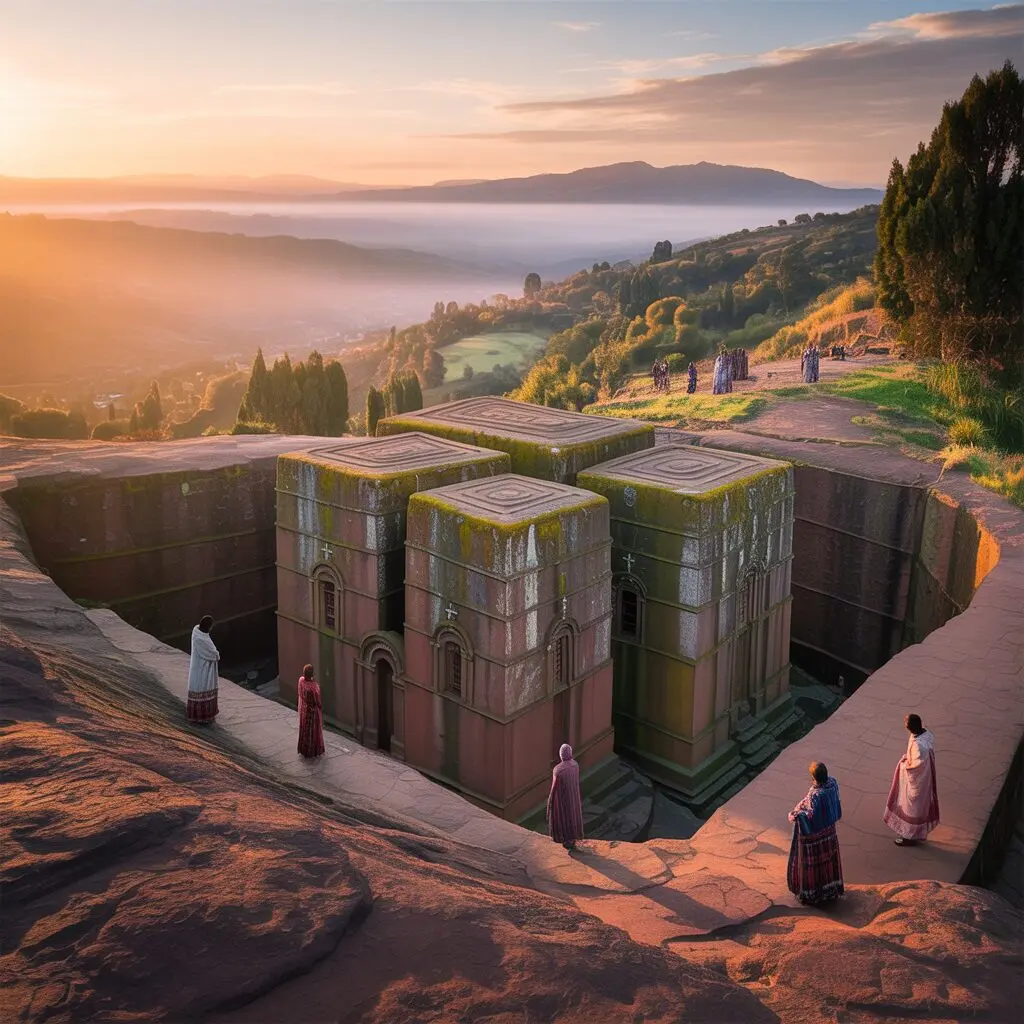
Standing apart from the two main groups, Bete Giyorgis (Church of Saint George) is the most iconic of all Lalibela’s churches. Carved as a perfect cube and descending into a pit carved from the surrounding rock, it is decorated with three Greek crosses on its roof. This is the image that defines Lalibela for most visitors and is the most photographed structure in Ethiopia.
When to Visit Lalibela
Lalibela can be visited year-round, but the most spectacular time is during major Ethiopian Orthodox festivals:
- Genna (Ethiopian Christmas) — January 7: Thousands of white-robed pilgrims gather for all-night ceremonies; one of Ethiopia’s most atmospheric events
- Timkat (Epiphany) — January 19: Dramatic processions re-enacting the baptism of Christ
- Fasika (Easter) — Usually April: Orthodox Easter celebrations including all-night services
- Meskel — September 27: Finding of the True Cross festival
During major festivals, Lalibela becomes extremely crowded — book accommodation 3-6 months in advance for Genna and Timkat. The dry season (October-May) is generally the best time for comfortable travel conditions.
Getting to Lalibela
Lalibela is served by Lalibela Airport (LLI), with daily Ethiopian Airlines flights from Addis Ababa (1 hour). This is by far the most practical option — the road journey from Addis is 1-2 days over difficult terrain and is not recommended for most tourists.
Lalibela is also a stop on the “Northern Historic Route” that connects Bahir Dar, Gondar, and Axum — all accessible by domestic flights with Ethiopian Airlines.
Practical Tips for Visiting Lalibela
- Admission: A ticket covering all churches costs approximately $50 USD for foreigners (check current rates locally). The ticket is valid for 5 consecutive days, allowing multiple visits.
- Guide: Hiring a licensed local guide ($15-30 per day) is strongly recommended. The churches’ history and symbolism are rich and complex — a guide transforms the experience.
- Dress code: Modest dress required — cover shoulders and knees. You will remove shoes many times. Comfortable slip-on shoes recommended.
- Photography: Photography of the exteriors is generally permitted. Interior photography rules vary by church — ask your guide. A photography permit may be required.
- Altitude: Lalibela sits at 2,630 meters. Acclimatize slowly if coming from lower elevations.
- Best time of day: Early morning (7-9am) before tour groups arrive, or late afternoon for the best light and fewer crowds.
Accommodation in Lalibela
Lalibela has limited but growing accommodation options:
- Ben Abeba Restaurant and Guesthouse — Unique architecture overlooking the valley; popular with international visitors
- Seven Olives Hotel — Reliable mid-range option with views toward the churches
- Unique Guesthouse — Budget-friendly option with basic amenities
- Wilderness Lalibela — Boutique lodge with stunning valley views
Book well in advance for any festival period.
Frequently Asked Questions
How many days do I need in Lalibela?
Plan for at least 2 full days in Lalibela to see all 11 churches comfortably. If visiting during a festival, you’ll want 3-4 days to experience the ceremonies and explore at a relaxed pace.
How do I get to Lalibela from Addis Ababa?
Fly with Ethiopian Airlines from Addis Ababa to Lalibela Airport (LLI) — approximately 1 hour. Daily flights operate year-round. Road travel is 1-2 days over rough terrain and is not practical for most tourists.
Is Lalibela worth visiting?
Absolutely — Lalibela is consistently ranked among the world’s great heritage sites and one of Africa’s must-visit destinations. The scale, craftsmanship, and living religious tradition of the churches make it a profoundly moving experience.
Do I need a visa to visit Lalibela?
Yes — an Ethiopia visa is required. Apply for the online Ethiopia eVisa at evisa.gov.et before travel ($62 for 30 days). The eVisa is valid for entry through Addis Ababa Bole International Airport.